The Vitruvian Problem:
On the Myth of the Well-Rounded Student
The Vitruvian Problem:
On the Myth of the Well-Rounded Student
“To be a Harvard Man”.
A 17-year old applicant concludes his five-sentence answer to the “Why Harvard” question with this singular aspiration. Indeed, future President John F. Kennedy would go on to become one.
When President Kennedy invoked the “Harvard Man” in his 1935 application, he was referencing a distinct social and intellectual category. Not limited to a specific school, the Harvard Man was a recognizable type: classically educated, broadly cultivated, morally formed. The classic archetype capable of discussing Thucydides over lunch, and rowing on the Charles in the afternoon.
“To be a Harvard Man”.
A 17-year old applicant concludes his five-sentence answer to the “Why Harvard” question with this singular aspiration. Indeed, future President John F. Kennedy would go on to become one.
When President Kennedy invoked the “Harvard Man” in his 1935 application, he was referencing a distinct social and intellectual category. Not limited to a specific school, the Harvard Man was a recognizable type: classically educated, broadly cultivated, morally formed. The classic archetype capable of discussing Thucydides over lunch, and rowing on the Charles in the afternoon.
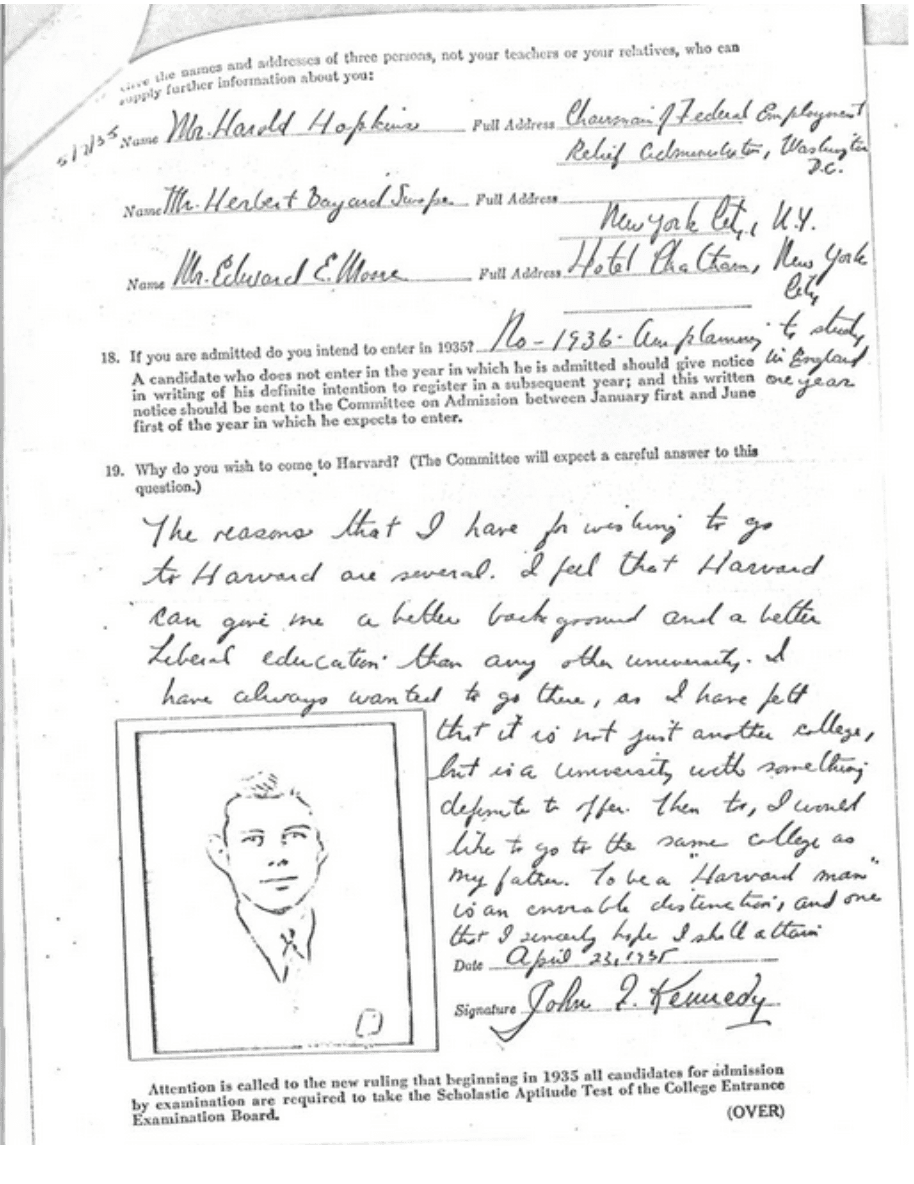
John F. Kennedy's Harvard Application (1935)
"The reasons that I have for wishing to go to Harvard are several. I feel that Harvard can give me a better background and a better liberal education than any other university. I have always wanted to go there, as I have felt that it is not just another college, but is a university with something definite to offer. Then too, I would like to go to the same college as my father. To be a "Harvard man" is an enviable distinction, and one that I sincerely hope I shall attain."
"The reasons that I have for wishing to go to Harvard are several. I feel that Harvard can give me a better background and a better liberal education than any other university. I have always wanted to go there, as I have felt that it is not just another college, but is a university with something definite to offer. Then too, I would like to go to the same college as my father. To be a "Harvard man" is an enviable distinction, and one that I sincerely hope I shall attain."
The Death of an Archetype
Today, the Harvard Man does not exist - and with it, the cultural apparatus that gave the archetype meaningful substance. Within two generations, the Harvard Man has gone from a tangible ideal that future presidents aspired towards, to being reduced to a phrase that survives off of nostalgia and satire. The proximate cause to this phenomenon is volume. In 1945, Harvard admitted approximately nine out of ten students. By the mid-1990’s, one in four. Today, under one in twenty.
This shift did not occur because of a shift in the institution’s ambitions. It occurred because the applicant pool expanded aggressively, whilst Harvard’s class size has remained fixed since the 1960s. The evaluative problem facing admissions officers today is categorically distinct from those of previous eras: 30,000+ applicants for a fixed number of places, each to be assessed in minutes.
Yet, volume is merely a derivative mechanism towards a deeper rooted cultural shift. The postwar expansion of higher education under the GI Bill (1944) admitted a cohort of students that the old archetype had never accounted for. The ensuing Civil Rights movement and the admission of women set a precedent towards the broadening of the applicant pool beyond the narrow socioeconomic geography from which Harvard Men have historically been drawn.
The Standardized testing system reflected the replacement of the fit-to-type system to a measurement-of-an-individual system. The advent of the Internet further democratized the valuation of canonical knowledge that had once been a desired currency. To put it simply, the Harvard Man did not die of a single cause. He dissolved under changing conditions that no longer sustained him.
The Death of an Archetype
Today, the Harvard Man does not exist - and with it, the cultural apparatus that gave the archetype meaningful substance. Within two generations, the Harvard Man has gone from a tangible ideal that future presidents aspired towards, to being reduced to a phrase that survives off of nostalgia and satire. The proximate cause to this phenomenon is volume. In 1945, Harvard admitted approximately nine out of ten students. By the mid-1990’s, one in four. Today, under one in twenty.
This shift did not occur because of a shift in the institution’s ambitions. It occurred because the applicant pool expanded aggressively, whilst Harvard’s class size has remained fixed since the 1960s. The evaluative problem facing admissions officers today is categorically distinct from those of previous eras: 30,000+ applicants for a fixed number of places, each to be assessed in minutes.
Yet, volume is merely a derivative mechanism towards a deeper rooted cultural shift. The postwar expansion of higher education under the GI Bill (1944) admitted a cohort of students that the old archetype had never accounted for. The ensuing Civil Rights movement and the admission of women set a precedent towards the broadening of the applicant pool beyond the narrow socioeconomic geography from which Harvard Men have historically been drawn.
The Standardized testing system reflected the replacement of the fit-to-type system to a measurement-of-an-individual system. The advent of the Internet further democratized the valuation of canonical knowledge that had once been a desired currency. To put it simply, the Harvard Man did not die of a single cause. He dissolved under changing conditions that no longer sustained him.
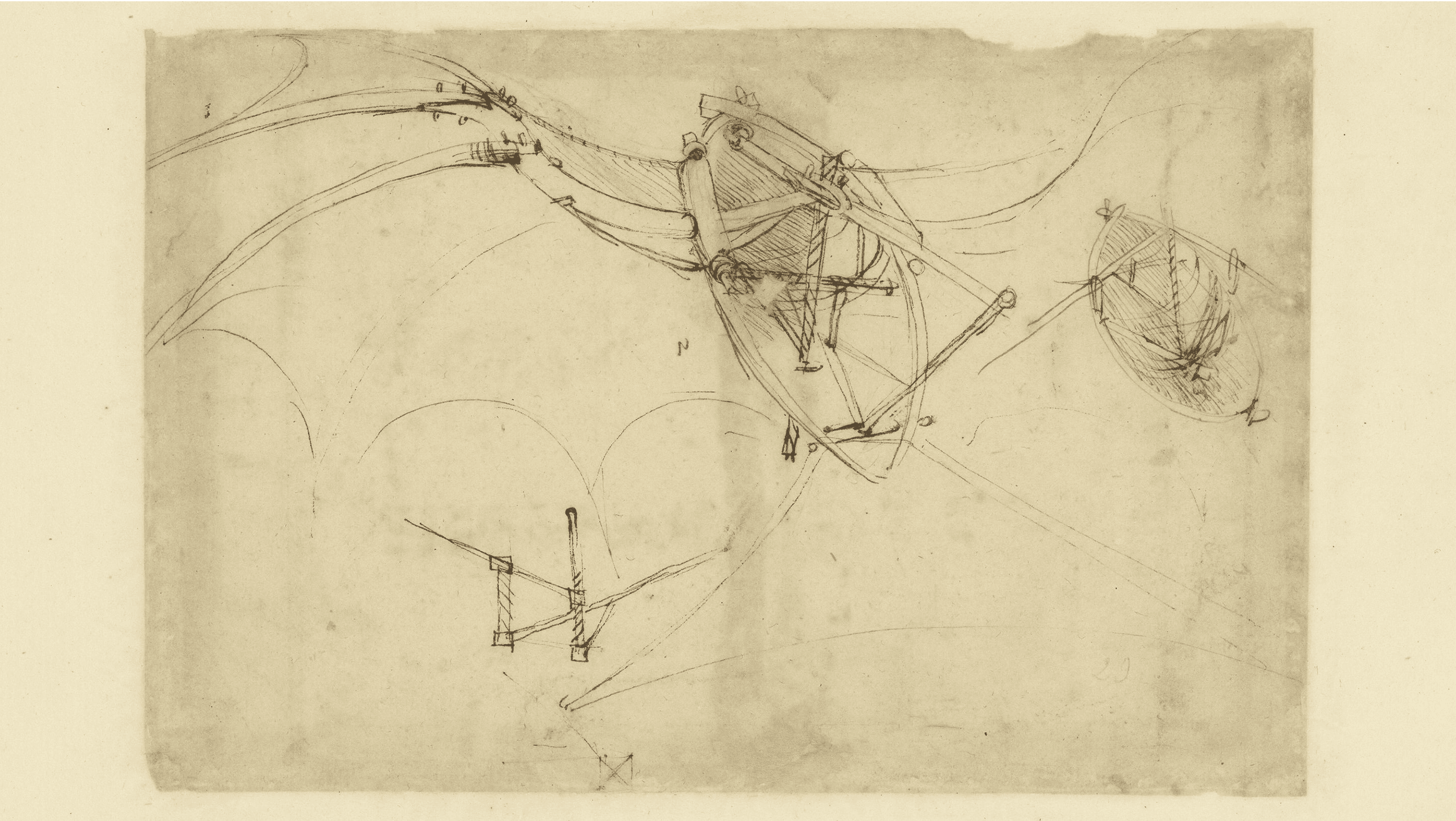
Codex Atlanticus, paper 860 recto - Leonardo Da Vinci (1452-1519)
Codex Atlanticus, paper 860 recto- Leonardo Da Vinci (1452-1519)
A Brave New World: The Rise of Esoteric Nuance
Assemble a well-rounded class, not a class of well-rounded students.
The term “well-rounded” has receded from admissions discourse, replaced by “angular,” “pointy,” “spiky,” “niche”. Peter Johnson, the former Director of Admissions at Columbia, describes the sought-after student as a “Niche applicant”. A student who has demonstrated deep, penetrative intellectual curiosity and expertise in a defined area.
This shift in language is reflective of a larger terminal transformation in the evaluative framework of an applicant. What the admissions office now expects from a seventeen-year old is a coherent intellectual posture. A demonstrated relationship with some distinctive dimension of the world.
The demand borders on the unreasonable. Few adults could produce on command what admissions officers ask of adolescents. But the sheer volume of the applicant pool makes the demand feasible, and so the demand stays.
The common advice still in circulation today - be well-rounded, show leadership, demonstrate passion - is advice for an evaluative world that no longer exists.
A Brave New World: The Rise of Esoteric Nuance
Assemble a well-rounded class, not a class of well-rounded students.
The term “well-rounded” has receded from admissions discourse, replaced by “angular,” “pointy,” “spiky,” “niche”. Peter Johnson, the former Director of Admissions at Columbia, describes the sought-after student as a “Niche applicant”. A student who has demonstrated deep, penetrative intellectual curiosity and expertise in a defined area.
This shift in language is reflective of a larger terminal transformation in the evaluative framework of an applicant. What the admissions office now expects from a seventeen-year old is a coherent intellectual posture. A demonstrated relationship with some distinctive dimension of the world.
The demand borders on the unreasonable. Few adults could produce on command what admissions officers ask of adolescents. But the sheer volume of the applicant pool makes the demand feasible, and so the demand stays.
The common advice still in circulation today - be well-rounded, show leadership, demonstrate passion - is advice for an evaluative world that no longer exists.

John F. Kennedy and Joseph P. Kennedy, Harvard Campus (1937)
John F. Kennedy and Joseph P. Kennedy, Harvard Campus (1937)
If Not a Harvard Man, Who Are You?
No seventeen-year-old in 1935 was asked this question in the sense the modern application demands. The question simply did not arise. To be a Harvard Man was to lay claim to a preconceived identity; one that the institution and the cultural zeitgeist had already written. The application simply confirmed the fit. The freedom implicit in that arrangement was the freedom from self-definition. This freedom was also the cost of self-expression.
What the modern applicant inherits is a license. For the first time in the history of elite admissions, the applicant is encouraged, expected even, to arrive with a self: articulated, examined, and expressed on their own terms. Unprecedented creative liberty.
The essay that President Kennedy wrote in five sentences could be written by almost any student of his class and background. The essay a contemporary applicant must write can only be written by that applicant. The shift from fit to construction is, at its core, a shift from inherited identity to authored identity. That authorship is difficult. It is also the first time in the history of this process that such an invitation has been extended.
This is the work that is worth executing at the highest level. Not to fit an archetype that no longer exists, but to render, with precision and emotional forte, the shape of a mind that declares its own.
If Not a Harvard Man, Who Are You?
No seventeen-year-old in 1935 was asked this question in the sense the modern application demands. The question simply did not arise. To be a Harvard Man was to lay claim to a preconceived identity; one that the institution and the cultural zeitgeist had already written. The application simply confirmed the fit. The freedom implicit in that arrangement was the freedom from self-definition. This freedom was also the cost of self-expression.
What the modern applicant inherits is a license. For the first time in the history of elite admissions, the applicant is encouraged, expected even, to arrive with a self: articulated, examined, and expressed on their own terms. Unprecedented creative liberty.
The essay that President Kennedy wrote in five sentences could be written by almost any student of his class and background. The essay a contemporary applicant must write can only be written by that applicant. The shift from fit to construction is, at its core, a shift from inherited identity to authored identity. That authorship is difficult. It is also the first time in the history of this process that such an invitation has been extended.
This is the work that is worth executing at the highest level. Not to fit an archetype that no longer exists, but to render, with precision and emotional forte, the shape of a mind that declares its own.
CONTINUE READING -




New York: 250 E 25th Street, New York, NY 10010
Seoul: 416 Hangang-Daero, Jung District, Seoul, South Korea
Munich: Walter-Gropius-Straße 17, 80807 München, Germany
© 2026 Estoire Consulting
New York 250 E 25th Street, New York, NY 10010
Seoul 416 Hangang-Daero, Jung District, Seoul, South Korea
Munich Walter-Gropius-Straße 17, 80807 München, Germany
New York 250 E 25th Street, New York, NY 10010
Seoul 416 Hangang-Daero, Jung District, Seoul, South Korea
Munich Walter-Gropius-Straße 11, 80807 München, Germany
© 2026 Estoire Consulting
© 2026 Estoire Consulting